Close calls · 1895–1899
The Venezuela crisis that threatened a wider war
In 1895, an argument over British Guiana’s boundary brought a threat from Washington. A treaty eased the crisis. Its map did not settle the dispute.
In this story
On 17 December 1895, President Grover Cleveland asked Congress to fund a boundary commission. He also attached a threat. If Britain held territory the American inquiry judged Venezuelan, the United States should resist by every means in its power.
The disputed border lay between Venezuela and British Guiana. Britain had refused arbitration of the entire claim; Cleveland proposed an American finding that neither claimant had agreed to accept. His message did not order a mobilization. The confrontation moved toward a treaty and an arbitral award, but the resulting line did not end the dispute.
A survey, then a rupture
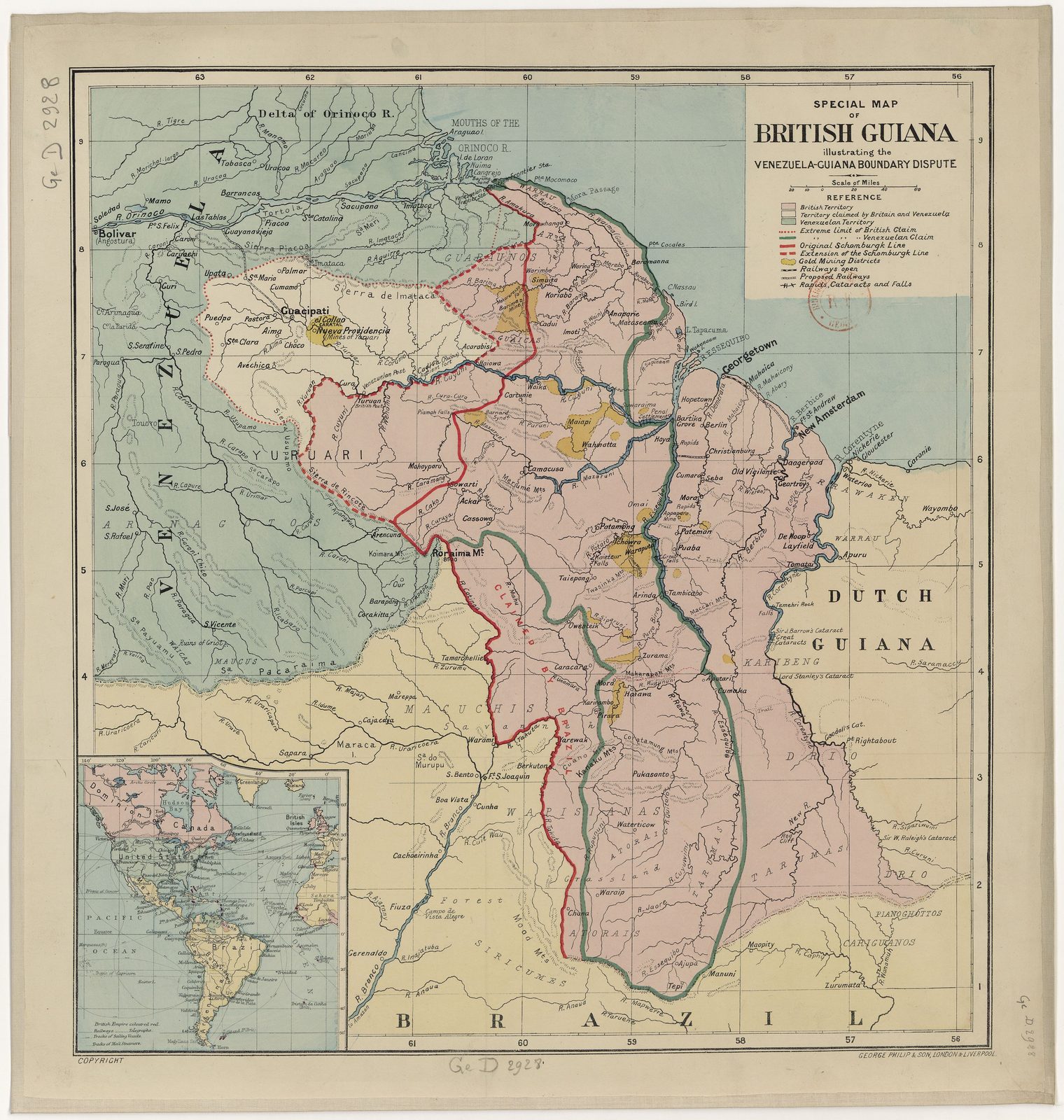
The ground was older than either cabinet. Britain held the colonies the Dutch had ceded at the end of the Napoleonic wars and called them British Guiana. Venezuela inherited the Spanish claim on the other side of a watershed nobody had fenced. Between the Essequibo and the Orinoco there was room for two maps. Robert Schomburgk’s survey of 1841, made for Britain, offered one of them. It was a surveyor’s line, with posts, not a treaty Venezuela had signed. Later British administration did not stay pinned to every post he had suggested, and Venezuela’s claim ran much farther east than Britain would discuss. Gold workings in the interior, later in the century, raised the price of a pencil mark. This essay will not assign a particular creek’s gold to a particular year so the motive looks cleaner than the correspondence.
The break is dated in Salisbury’s own reply, which is the British statement of the file and not a neutral chronicle. Venezuela addressed notes to the British minister at Caracas on 26 and 31 January 1887. They demanded evacuation of the territory Britain held from the mouth of the Orinoco to the Pomeroon, and they said that if the evacuation and an acceptance of arbitration had not come by 20 February, relations would be broken. They were broken. Salisbury’s dispatch of 26 November 1895 says the question had sat in that position ever since. Venezuelan plenipotentiaries came to London in 1890, 1891, and 1893. The bases Britain was willing to negotiate were not the bases Venezuela was willing to sign, because Venezuela still wanted arbitration of a claim Britain said would have cut into the colony itself. That is Salisbury’s sentence. It is one party’s brief. It is also the brief the American intervention walked into.
A doctrine that was not a treaty
Venezuela did not wait for the two empires to notice. Its government kept bringing the boundary to Washington and asking the United States to treat the dispute as its own business. William L. Scruggs, a former American minister retained by Venezuela, circulated a pamphlet, British Aggressions in Venezuela, or the Monroe Doctrine on Trial. A pamphlet written for a client is a public fact. It is not a neutral archive, and a reader who meets the crisis first in that title has already been handed a verdict.
The Monroe Doctrine was a presidential message of 1823. It was not a statute, and it was not an instrument Britain had signed. Olney’s instruction of 20 July 1895, addressed to Thomas F. Bayard, the ambassador in London, told him to read it to Salisbury and to leave a copy if Salisbury wanted one. The sentence that still gets detached from the page is Olney’s description of the hemisphere: the United States is “practically sovereign on this continent, and its fiat is law upon the subjects to which it confines its interposition.” He asked for a definite decision. Would Britain submit the Venezuelan boundary question in its entirety to impartial arbitration, or would she decline? Cleveland had approved the instruction. The hope, Olney wrote, was arbitration. The alternative, he said, would embarrass the future relations of the two countries, and the president wanted to know in time to lay the subject before Congress.
That is a large claim written in the voice of a foreign office that had decided a colonial boundary was no longer only colonial. It is also a question, not a fleet. Salisbury took his time. The replies are dated 26 November 1895, four months after the instruction, and there are two of them on the same day. One rejected the Monroe Doctrine as a rule of international law and as a reason the United States could demand to umpire a boundary between Britain and another American state. The other walked the history as Britain saw it: the line, the occupation, the 1887 notes, the missions that had failed. Arbitration of the entire Venezuelan claim, including districts Britain said it had long administered, was declined. The refusal is in the dispatches. It is not a mood.
The message, then a commission nobody had joined
Cleveland had mentioned the controversy in his annual message of 3 December. The special message of 17 December is the one the hook uses. He told Congress that years of urging Britain toward arbitration had ended in a refusal, and that Venezuela had not accepted Britain’s present proposition. Any boundary Venezuela freely signed, he said, the United States could not object to. What he proposed instead was an American commission, funded by Congress, to investigate and report the true line. Then the sentence. When that report was made and accepted, it would in his opinion be the duty of the United States “to resist by every means in its power” a British appropriation of lands, or a British jurisdiction over territory, which the investigation had determined belonged to Venezuela. He called that appropriation a willful aggression on the rights and interests of the United States.
Congress answered with an act of 21 December 1895. The commission’s own letter to the president says the members were appointed on 1 January 1896 and that they met on 4 January at the Department of State, electing David J. Brewer as president and Severo Mallet-Prevost as secretary. A message William McKinley sent the Senate in May 1897 dates the appointment to 4 January 1896. Both dates stay. The names on the commission’s signature are Brewer, Richard H. Alvey, Frederic R. Coudert, Daniel C. Gilman, and Andrew D. White. The commission’s letter is frank about what the board was not. Neither Britain nor Venezuela had been consulted in creating it. Either government could have ignored a body invented by a country that was not a party to the territory. Cleveland’s message had suggested the United States would not ignore the result. That suggestion is the threat. It is not a fleet list. This essay will not supply one. There is no landing in this file.
What people remember beside the message is noise and a market. Papers in both countries wrote the war up in the days after 17 December, and American securities fell hard enough that the sentence acquired a price. Almost Lore will not invent a percentage for that fall. The preparations that can be documented are the message, the statute, and the commission. They are not regiments on a beach. A separate quarrel arrived in the same fortnight: on 3 January 1896 the German emperor telegraphed his congratulations to Paul Kruger after the Jameson Raid. That telegram is not the cause of anything Salisbury then did about the Essequibo. It is a reminder that the British cabinet already had a worse week available, and that an American war over a river mouth was not the only file on the desk.
A treaty with a fifty-year rule
Through 1896 the refusal of November turned into a negotiation. The instrument is dated, which is more useful than a story about who blinked. On 2 February 1897, at Washington, Britain and Venezuela signed a treaty to arbitrate the boundary. Sir Julian Pauncefote signed for Britain. José Andrade, Venezuela’s minister in Washington, signed for Venezuela. The parliamentary paper, Treaty Series No. 5 of 1897, puts the exchange of ratifications at Washington on 11 June. The United States is all over the politics of the treaty and is not a party to it. Cleveland’s fiat is not an article.
The tribunal was five jurists. The treaty names them on four of the chairs and a method for the fifth. Britain’s two, nominated by the Judicial Committee of the Privy Council, were Baron Herschell and Sir Richard Henn Collins. On Venezuela’s side of the page, Melville Weston Fuller, chief justice of the United States, was named by Venezuela, and David Josiah Brewer was named by the justices of the United States Supreme Court. The fifth, chosen by those four or, if they failed, by the king of Sweden and Norway, would preside. The four chose Frederic de Martens, the Russian jurist. Herschell died before the tribunal finished, and Lord Russell of Killowen sat in his place under the vacancy rule the treaty had already written. They were to meet in Paris. Decisions, including the final one, were by majority.
Article IV is the part a Monroe Doctrine story leaves out. The arbitrators were to apply rules the parties had agreed, and international law only where it did not contradict those rules. The first rule is a sentence: adverse holding or prescription during fifty years shall make a good title. Exclusive political control of a district, as well as actual settlement, could be enough to count. That is how Britain’s refusal to arbitrate “settled districts” survived inside an arbitration of the whole question. Occupation could ripen. A reader who wanted a pure inquiry into Spanish and Dutch titles of the seventeenth century was not going to get one unaltered. The rule is printed in the treaty. It is not a secret codicil discovered later to explain an embarrassing map.
The award is dated 3 October 1899. It was unanimous, which a majority rule did not require and which a revenge story cannot use. It did not give Venezuela the Essequibo, and it did not give Britain the mouth of the Orinoco. Venezuela received the Orinoco mouth. British Guiana received the larger share of the inland territory that had been in dispute, on a line later descriptions place close to Schomburgk’s survey. This essay will not redraw the creeks. The award is a document with a date. It is not a statement that the people who lived between the rivers had been asked.
What the award did not close
The near-war of 1895 ended in a treaty, not in a battle. The boundary did not end as a controversy, and it is a distortion to write the award as if it had. In 1949, after Mallet-Prevost’s death, a memorandum he had left was published. He had been secretary of the American commission and counsel on the Venezuelan side at Paris. The memorandum alleges that the award was a political bargain rather than a judicial finding. That is a later allegation by an interested man. It is not the award, and it is not something this essay can confirm or dismiss from the treaty text. Venezuela treated the 1899 line as tainted. Britain and, later, Guyana treated it as the boundary.
In 1966, as British Guiana approached independence, Britain and Venezuela signed the Geneva Agreement, which recorded the controversy as still open and substituted a process for a parade. The disagreement has since been put before the International Court of Justice. None of that is a second Cleveland message, and none of it is a reason to narrate 1895 as if the jurists were already writing a brief for a later century. It is the reason a clean ending — they arbitrated, and the map was finished — asks 1899 to close a sentence the parties are still in.
Why the hook is not the essay
The compressed line needs a bully and a blink. Olney declares the continent an American possession. Cleveland threatens war. Salisbury scoffs. A market panic brings Britain to heel. A courtroom then gives the jungle to the empire that already held it. The file is less obliging. Olney’s sentence about practical sovereignty is in the instruction, and it is as large as it sounds. Salisbury’s refusal is also in writing, and it is a refusal of a doctrine Britain had not signed, not a confession that the colony had no title worth arguing. Cleveland’s “every means” is a conditional duty he stated to his own Congress, attached to a commission that had not yet been named, about a line the United States was not a party to. The climb-down was mutual. Britain accepted an arbitration it had refused in November. The United States accepted a treaty in which an American commission’s fiat was not the rule of decision. The fifty-year rule is how occupation stayed in the case after the threat had been put away.
The useful near-miss is the distance between a sentence and a war. In December 1895 two governments that were not going to land battalions on that river were willing to let a boundary they did not share become a question of national honor. They hired jurists instead. The honor survived. The line did not settle the honor, and it did not settle the neighbors. If you came for the almost-war, it is the message of 17 December and the fact that no one acted it out. The story that can survive a footnote is the one in which that message produces a treaty, a prescription rule, and a dispute that outlived every man who signed either.
A story worth passing on?