Close calls · 1859–1872
The Pig War: one shot, thirteen years of waiting
A pig wandered into an American settler’s garden in 1859. His shot brought troops to San Juan Island, where the border remained unsettled until 1872.
In this story
On 15 June 1859, an American settler on San Juan Island shot a Hudson’s Bay Company pig rooting in his garden. What followed was far larger than a quarrel over an animal. American troops landed. British warships arrived. Both governments claimed the island, and neither wanted the other to turn a landing into possession.
The border dispute was already thirteen years old. The 1846 Oregon Treaty sent the boundary through “the middle of the channel” between the mainland and Vancouver Island. There was more than one channel. One route favored Britain; another favored the United States. The islands already had their own people. The treaty settled a claim between empires without settling where, on this water, that claim would end.
A farm, a tax bill, a potato patch
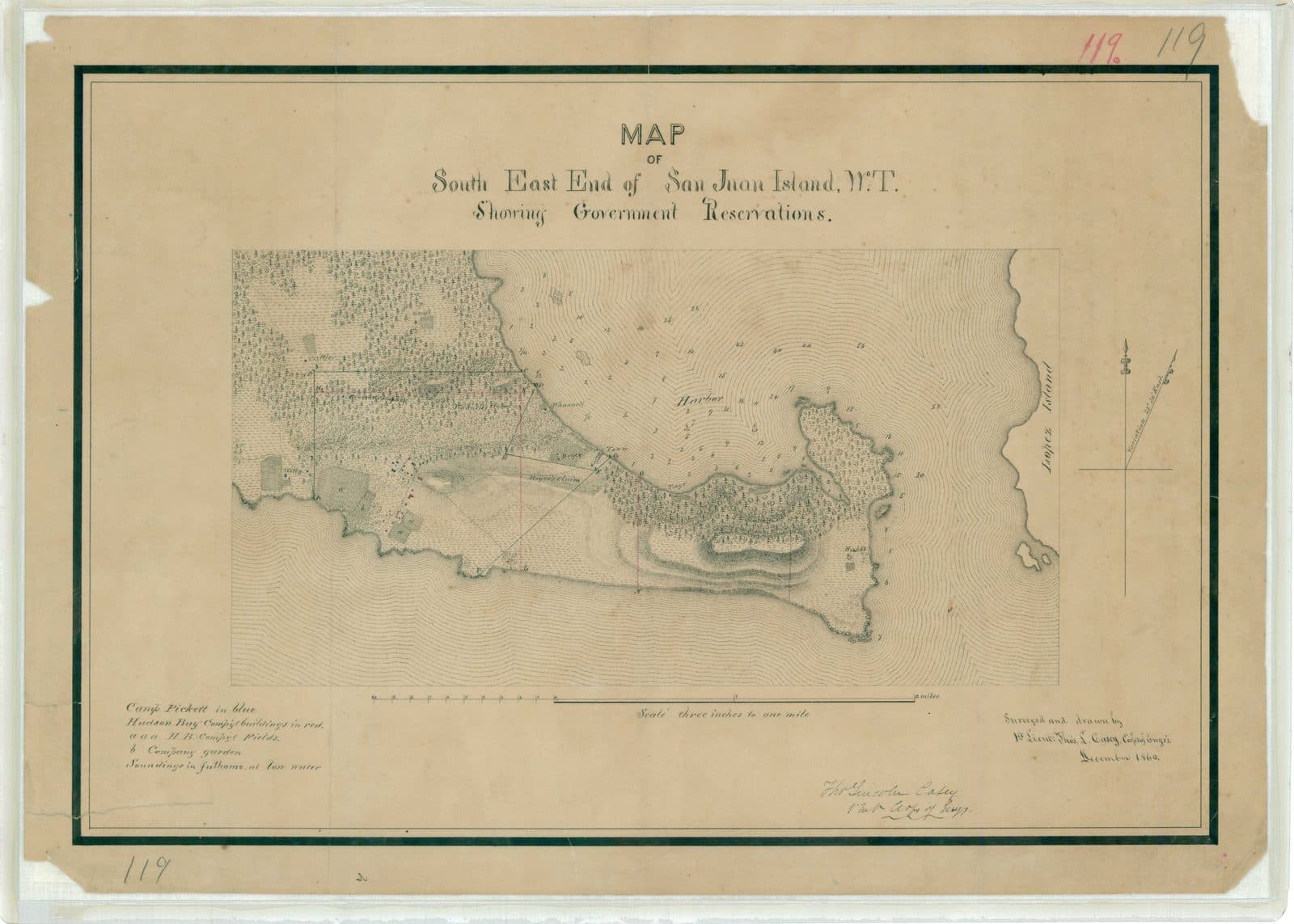
The Hudson’s Bay Company moved first. A salmon station in 1851, then, in December 1853, a sheep farm on the southern end of San Juan Island. Charles John Griffin managed it and named it Belle Vue. He brought sheep, seed, and Berkshire boars. American officials answered with customs demands and, from Whatcom County, a sheriff who tried to collect taxes by auctioning company sheep off a beach at night. In Washington, the Secretary of State told the territorial governor to stop poking the dispute until a boundary commission existed. The commission met. It did not settle San Juan.
American settlers, many of them back from the Fraser River gold rush, began taking patches of the island in 1858 and 1859. Lyman Cutlar arrived in April 1859 and started a claim a short walk north of Belle Vue’s headquarters. His garden was not much of a fence. One of Griffin’s boars kept coming into the potatoes. On 15 June 1859 Cutlar shot it. He went to Griffin, offered to replace the animal, and met a price. Griffin wanted $100. Cutlar said it was not worth $10. Company officers who were on the island confronted him. What was said in that meeting was later disputed. Cutlar’s version, the one that traveled to American officials, was that he would be taken to Victoria and tried if he did not pay.
The petition that did not mention the pig
No one arrested him. The settlers raised a flag anyway. On the Fourth of July, HistoryLink’s account — following Vouri — puts fourteen of them at the cabin of deputy customs collector Paul Hubbs, on the hill above the farm, with a new fifty-five-foot pole. A few days later Brigadier General William S. Harney, commanding the Army’s Department of Oregon and already disliked in London’s corner of the Northwest, saw the flag from the water and came ashore. The settlers asked for troops. Harney told them to write it down.
The petition of 11 July, signed by Hubbs, Cutlar, and others, did not mention the pig or the Hudson’s Bay Company. It asked for protection from raids by northern indigenous nations. Those raids were a real fear on the Sound; the collector Isaac Ebey had been killed in one in 1857. Harney’s later explanation to his own superiors leaned on a different sentence: Americans had to be shielded from the company’s “oppressive interference.” The written request and the general’s reason are not the same document. Almost Lore will not collapse them into a single motive so the story starts cleanly at the potato patch.

Pickett’s morning, Hornby’s refusal
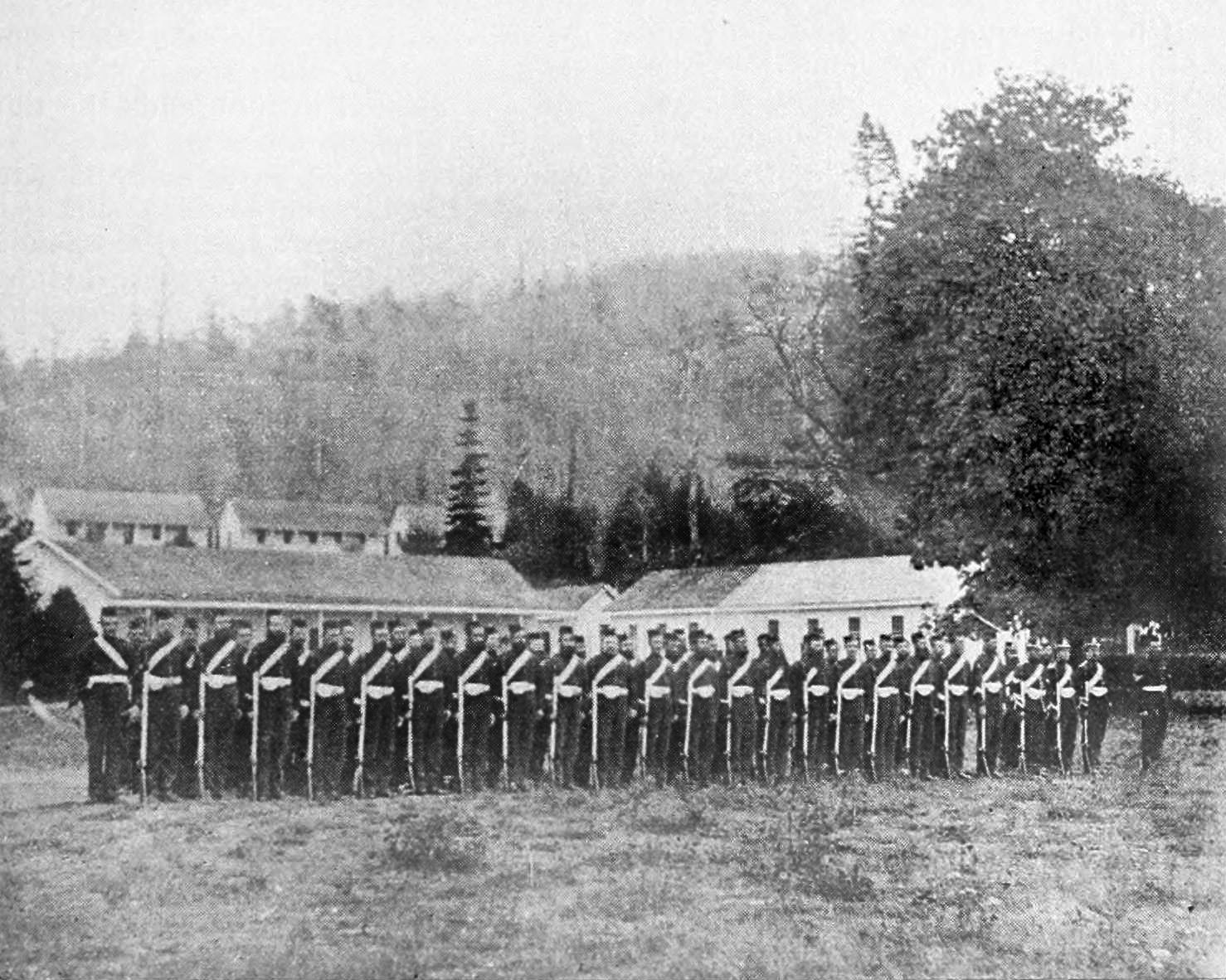
On 18 July Harney ordered Captain George E. Pickett to leave Fort Bellingham and occupy the island. Pickett’s company reached the Hudson’s Bay Company harbor — Griffin Bay — on the evening of 26 July and began making camp above the dock the next morning. The park’s short history dates the landing to 27 July, which is that morning, and gives the strength as sixty-four men. This essay has not counted the roll. Pickett posted a proclamation. HistoryLink, quoting Edmond Meany, records the operative line: “This being United States territory, no laws, other than those of the United States, nor courts, except such as are held by virtue of said laws, will be recognized or allowed on this island.”
Governor James Douglas, at Victoria, was also the acting naval commander while Rear Admiral Lambert Baynes was away. He sent Captain Geoffrey Hornby in HMS Tribune with orders to stop the Americans fortifying the island. Hornby decided one ship was not enough. Douglas then ordered marines landed to balance Pickett. The marines were in the harbor by 2 August. On the afternoon of 3 August the British captains met Pickett, who had moved his camp over the hill to South Beach and who said he would fight a landing. Hornby did not believe the man was bluffing. He also did not land the marines. He waited for the admiral.
That is the near-miss, and it is less quotable than a pig. Later tellings like a line from Baynes about two great nations and a squabble. The decision HistoryLink puts first belongs to Hornby, on the ground, declining an order that would have put royal marines in front of an infantry company whose captain had already promised a fight. The pig was weeks dead. The war was still optional.
Thirteen years of a war that did not start
The optional war stayed unfought and did not go away. Reinforcements gathered on both sides through the late summer. In the autumn General Winfield Scott came out and arranged a drawdown: one American company, a British ship, and a joint occupation until the governments could stand to finish the sentence they had left open in 1846. Harney was rebuked for letting it swell. On 21 March 1860, royal marines landed on Garrison Bay and built the post now called English Camp. The American camp stayed at the south end. The Civil War began the next year. Pickett would become a Confederate general. San Juan stayed a quiet, armed ambiguity.
In 1871 the Treaty of Washington sent the water boundary to the German emperor, Wilhelm I. He handed it to a three-man commission. On 21 October 1872 the award ran the line through Haro Strait. The San Juans were American. The royal marines left English Camp on 25 November 1872. The last American troops left in July 1874. The National Park Service ends where the label ends: a war remembered because the only casualty was a pig. Read as a claim about the two detachments, it holds. They did not fire on each other. Read as a claim that the thirteen years contained no other death, it is the hook again, asking a potato patch to stand for a border.
Why the hook is not the essay
A compressed line needs a villain and a punch line. Griffin is greedy, Cutlar is a farmer, the empires are absurd, the pig is the moral. The file is duller and better. A treaty used the word “channel” in a place that has two. A company farm and a homestead law occupied the same grass. A petition asked for help against raids while the general who suggested the petition explained himself with the company. A captain declined to land marines. An emperor’s commission picked a strait.
If you came for the pig, it is there: 15 June 1859, a Berkshire boar in an unfenced garden, a price argued between ten dollars and a hundred. The story that can survive a footnote is the one in which that shot does not start a battle, and the boundary is still unset when the boar is bones.
A story worth passing on?