Close calls · 1861–1862
The four men taken off the Trent
A Union captain seized four men from a British mail ship in 1861. Britain demanded their return. The Civil War nearly acquired another front.
In this story
The British mail steamer Trent was on a lawful voyage when a Union warship stopped her on 8 November 1861. An armed party took four men: two Confederate commissioners and their secretaries. The mail and the ship went on. The prisoners did not.
Captain Charles Wilkes had acted without orders from Washington. London demanded the men’s release and an apology, while Britain sent troops toward Canada and ships toward the western Atlantic. Nobody had died aboard the Trent. The question was whether one captain’s decision would open another war while the United States was already fighting its own. Seward’s eventual answer released the men without producing agreement on every point of law.
A passage that was not a secret
In May 1861 Britain had already done the thing the Confederacy wanted halfway. Queen Victoria’s proclamation of neutrality treated the Confederate States as a belligerent. That is not recognition of a government. It is recognition of a war, and it is what lets a neutral’s merchant ships claim the ordinary protections of neutral trade. France took the same posture. Jefferson Davis wanted the other half: reception of commissioners as the agents of a sovereign state, and the trade and the credit that reception would unlock. Mason, who had chaired the Senate Foreign Relations Committee in the old Union, was sent toward Britain. Slidell, a New Orleans lawyer, was sent toward France.
They did not stroll out of a harbor the blockade had forgotten. In October they ran from Charleston to Cuba. From Havana they took the Trent, a British mail steamer, for St. Thomas and England. She left Havana on 7 November. Wilkes was not in the channel because the Navy Department had handed him a chart and four names. He was a captain already in the West Indies who heard that the commissioners would take the British packet, and he waited. The Office of the Historian’s summary is plain about the authority: he intercepted the Trent without permission from Washington. The near-miss begins as one officer’s decision, not as a cabinet’s.
The channel itself is worth keeping straight, because the hook likes to put the stop inside British water. The injury London complained of was a British-flag mail ship on a lawful voyage, stopped on the high seas, and the forcible removal of people from her. It was not a seizure inside a British port. A British hull does not turn the Bahama Channel into a British harbor. The neutrality is the flag and the voyage. The geography is not the crime.
Warning fire, then four men
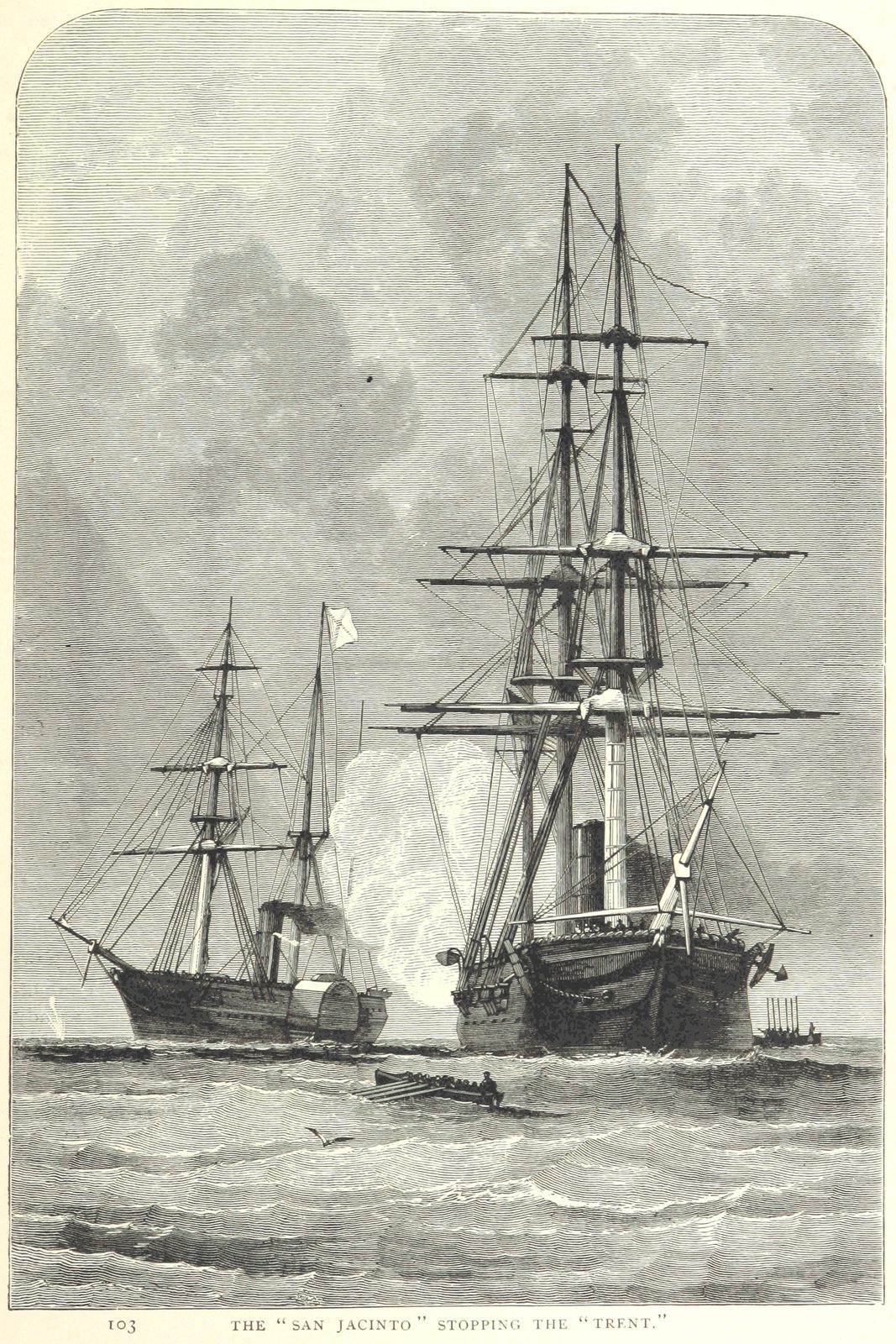
Around midday on 8 November the San Jacinto sighted the Trent under British colors and fired to bring her to. Later tellings disagree about the gunnery. The National Park Service’s short account has a shell striking the bow. The naval accounts that stay with warning fire have shots that made her heave to without turning the morning into an action. Almost Lore will not pick the strike so the boarding looks bloodier. What is stable is that the Trent stopped, and that an armed party went aboard.
Wilkes’s written order to his executive officer, Lieutenant Donald McNeill Fairfax, as the naval reports print it, was not a modest request for two gentlemen. Mason, Slidell, and the secretaries George Eustis and James E. Macfarland were to be taken, and the Trent was to be seized as a prize and sent in for a court. Fairfax brought off the four. He did not bring off the ship. Slidell’s wife and children were aboard and were not taken. The mail went on. No one was killed on the deck. That last sentence is the one a war story has to step over. The Trent affair is a diplomatic crisis with a body count of zero. The Caroline, a generation earlier on the Niagara, had a dead man on the dock. This one had prisoners and a theory.
The theory was Wilkes’s. He treated the commissioners as the embodiment of dispatches, contraband you could lift out of a neutral ship because the men were the message. It is a clever sentence. It was not a doctrine the British law officers were going to sign, and it was not a doctrine Seward’s own government was willing to adopt as instructions after the fact. A belligerent of that period could visit and search a neutral merchantman. A prize court was where a search became a title, or failed to. Removing the passengers and letting the hull go left Wilkes with men in a cabin and no judgment to point to. Fairfax’s decision not to take the ship is sometimes told as the act that kept the peace. It is just as easy to read it as the act that threw away the one procedure — a court — that might have made the seizure look like law. Seward would later describe the missing court as the error. Russell would later say that Britain did not share Seward’s conclusions about what Wilkes might lawfully have done instead.
Boston first, then a dispatch
The San Jacinto carried the four north. The Boston accounts put them at Fort Warren, in the harbor, by 24 November, which is the day the celebration uses. The North, still living with the summer’s defeat at Bull Run, treated the boarding as a victory that had not required a field. When Congress met, the House voted its thanks. The thanks were for an arrest. They were not a ruling on the law of nations, and they were not an order the cabinet could hide behind once the British mail arrived.
The Trent reached England with the mail and with the story. Palmerston’s government and Earl Russell, the foreign secretary, treated the removal as an affront and a breach of international law. The demand Russell sent Lord Lyons, the British minister in Washington, is the one he restated when the correspondence was printed: the four gentlemen were to be freed and delivered to Lyons, so that they could be placed again under British protection, and there was to be a suitable apology for the aggression. Britain also did what a government does when it is not sure a note will be enough. Troops were ordered to Canada. Additional ships were ordered toward the western Atlantic. The public summary records those orders. It does not pretend either capital wanted a second war on top of the one already being fought. Wanting is not the same as not preparing.
The seven days are real, and they are easy to turn into a shouted ultimatum. Russell’s dispatch of 9 December 1861, printed with the rest in the London Gazette of 14 January, tells Charles Francis Adams what the private letters actually said. Lyons was to talk the matter over with Seward two days before reading him the dispatch. The direction to leave Washington in seven days was not in the paper to be read. If Seward asked what a refusal would mean, Lyons was to decline to answer, so the interview would not open as a threat. Russell added that he thought an explanation — that the American government had not authorized the seizure — would stand in the place of an apology. The essential condition was the men. Adams asked whether Lyons’s departure would mean an immediate declaration of war. Russell’s own report of his answer is that nothing had been decided on that point; Britain would wait for the reply and then decide. The ultimatum was an ultimatum. It was written by men who were trying not to pronounce the word until the note failed.
A draft, a death, and a morning in December
Prince Albert’s last public work sits in the same week, and the hook has promoted it into a rescue. He was already ill. On 1 December 1861 he revised the draft that was about to go. The royal record of that month, including the queen’s account, keeps the revision as a fact. He died on 14 December 1861. What the revision changed was tone and an exit. The dispatch, as sent, still required the men and still asked for an apology, and it left room for Washington to say that Wilkes had not been authorized to insult the flag. The story that a dying prince prevented a war takes a real edit and makes it the cause. The edit mattered because it assumed an explanation might arrive. It did not bind Lincoln, move a regiment, or write Seward’s last page. Albert was dead before the American answer existed.
The paper was slow, which the milestone summary blames on a communication malfunction and which the calendar explains without a villain: a dispatch dated 30 November is not a telegram. Lyons had it in the middle of December and spoke to Seward before the formal reading. American calendars put Seward’s note on 26 December 1861. Lyons’s dispatch of the 27th says he received it that morning. The two dates are the same note, not two policies. Lyons, writing before the messenger left, did not pretend to have weighed every page. He reported the part his instructions had made essential. Seward admitted that reparation was due and consented to deliver the four prisoners. Lyons stayed at his post and sent the note home.
The note is a lawyer’s document, which is why the popular version cannot use it whole. Seward said no instructions had authorized Wilkes to do what he did. He did not adopt the particular act. He called it an inadvertency, a naval officer’s departure from a rule that was uncertainly established. He also wrote, at length, about what he thought a belligerent might have done instead, including taking the Trent before a prize court. He agreed that the four would be liberated, and he asked Lyons to name a time and a place. Russell, answering on 11 January 1862, took the liberation, the delivery, and the admission that there had been no orders, and concluded that they were the reparation Britain had a right to expect. He did not adopt Seward’s theory of the road not taken. He said Britain differed from some of those conclusions and would write the differences separately, and he wanted American commanders told not to repeat an act their own government could not undertake to justify. London’s acceptance is that January dispatch. It is not a shared textbook.
Why the hook is not the essay
On 1 January 1862 the four left American custody aboard the British ship Rinaldo. They reached England later that month. They were not received as the ministers of a recognized state. Britain’s neutrality, which both the Union and the Confederacy had hoped to bend, was still neutrality when the year turned. The commissioners’ voyage had produced a crisis and no recognition. That is the Confederate result, and it is smaller than the war the boarding had made discussable. Later retellings give Lincoln a neat sentence about fighting one war at a time. The sentence is not a dispatch. The policy is visible without it: the cabinet gave the men back rather than test the Royal Navy while a rebellion was in the field.
On a forum the Trent arrives as a dare that failed. Lincoln blinked, Britain rattled a fleet, a prince on his deathbed saved the Atlantic peace, and the South missed its chance to add a second enemy to the Union’s war. Pieces of the dare are in the file. Britain did move troops and ships. Washington did give the prisoners back. Albert did edit a draft and then die. The extra claims are doing the usual work. The release was a legal concession written so the United States could deny the act without signing Britain’s whole law of the sea. The prince’s edit was not a treaty. The missed chance assumes Britain was a battle away from recognizing the Confederacy, which the May proclamation and the January coldness to Mason do not support. Recognition was a separate decision. This crisis did not make it.
The useful near-miss is procedural. A captain without orders stopped a neutral mail ship, took four passengers, and let the hull go. That combination gave London a clean injury and gave Seward a way to call the injury real without a battle. No one died on the Trent. The shooting that did not happen would have been fought by other people, later, if the note Lyons received on 27 December had been a refusal. The men went on to Europe and did not become an alliance. The mail steamer finished her voyage. The prize court that never sat is the blank where a war would have had to find a better reason than a captain’s theory.
A story worth passing on?