Close calls · 1904–1905
Dogger Bank: the night the navy fired at fishermen
A Russian squadron mistook Hull trawlers for a threat in 1904. Two fishermen died. Britain and Russia then had to prevent a second disaster.
In this story
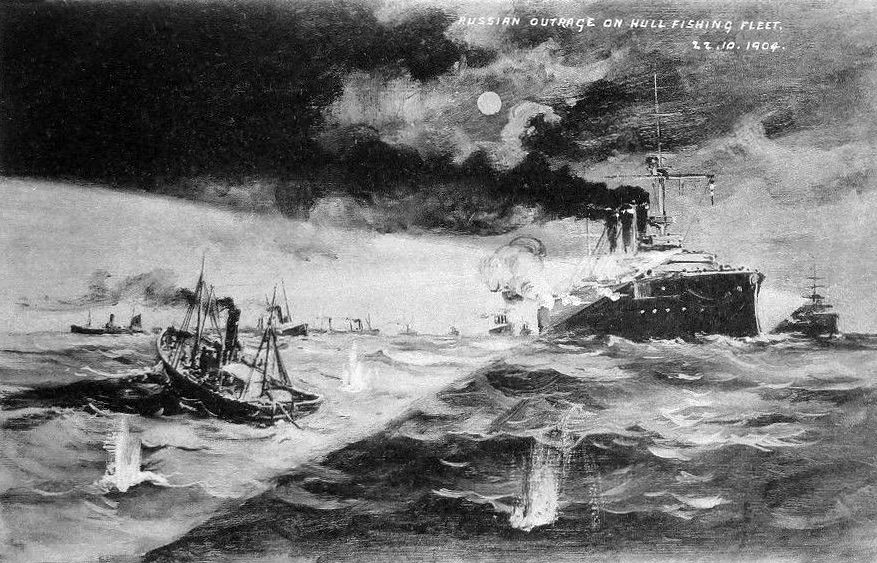
Searchlights swept the North Sea on the night of 21–22 October 1904. A Russian squadron, heading toward the war with Japan, had encountered Hull trawlers on the Dogger Bank. Then it opened fire. The trawler Crane sank. Two fishermen died.
The inquiry counted six wounded and five more boats damaged. A majority of commissioners found no torpedo boats among the trawlers or nearby. The firing was unjustified. Yet the same report unanimously defended the admiral’s military qualities and humanity. Britain and Russia stayed at peace. The report records the harm while showing how carefully the investigators avoided turning their findings into a fresh insult.
A message from a ship that had fallen behind
Russia was already at war with Japan. The Pacific squadron was shut up at Port Arthur. The remedy chosen in St Petersburg was to send the Baltic fleet around the world as a second Pacific squadron, under Rozhestvensky — the spelling in the commission’s English report is Rojdestvensky, and the letters move in every later retelling. The ships that matter to this night are not the whole line. The commission’s narrative follows a division that left Skagen on the evening of 20 October with the admiral, battleships and a transport, and the divisions astern of it, one of those including the cruisers Aurora and Dmitri Donskoi and the transport Kamchatka. Speeds were ordered. The formation did not keep them.
On the afternoon of 21 October the ships passed the English steamer Zero in turn. Her captain’s descriptions are one of the reasons the commission was willing to say who was where. The last of them, by that description, was the Kamchatka. She had been with the cruisers. Engine trouble had left her about ten miles astern, alone, and of little fighting value if the fear everyone was carrying turned out to be real. The fear was Japanese torpedo boats in European waters. It had been in the squadron’s nerves since the Baltic. The commission does not have to diagnose a mood. It has a message.
Toward eight that evening the Kamchatka met the Swedish steamer Aldebaran and other vessels she did not know, and opened fire. The report’s own reading, offered with a “doubtless” rather than a proof, is the unglamorous one: isolation, damaged engines, a ship that could not afford to be surprised. At 8:45 her commander telegraphed the flagship by wireless that he was “attacked on all sides by torpedo boats.” Rozhestvensky, the commission writes, then had to decide what to do with a report of attackers fifty miles astern who might, on his estimate, catch him around one in the morning. The sentence is the hinge. A transport that had already fired on neutral shipping, on a false or at least unproven alarm, had told the admiral the alarm was true. The Dogger Bank was still ahead of him.
Ten minutes, or something longer
The bank is a shoal and a fishery, not a battlefield anyone had scheduled. The commission describes the Hull fleet the squadron’s course was going to pass: some thirty small steam trawlers, scattered over miles of the usual grounds. They were fishing. A trawler with gear out does not accelerate like a boat built to throw a torpedo and leave. That is the fact that makes the mistake, if it was a mistake, so hard to sit with. It is also a fact the men on the bridges did not have in a calm form. They had searchlights, standing orders, and a wireless message from astern.
Under those orders the admiral marked what was to be fired at by putting his searchlight on it. Every other ship was sweeping the horizon with her own lights so as not to be the one surprised. The commission notes the obvious result: confusion, and no clean way to keep one circle of light as the only order. The firing that followed lasted, in the report, from ten to twelve minutes. It did the damage the report is willing to itemize. Two men were killed and six wounded. The Crane sank. The Snipe, the Mino, the Moulmein, the Gull, and the Majestic were hit. The cruiser Aurora was hit by several shots in that same firing. The trawlers were not armed to do it; the report leaves the shots inside the squadron’s own confusion. The majority of the commissioners said they did not have detail precise enough to say, target by target, what every ship had thought it was shooting. They were unanimous that the fishing vessels had done nothing hostile.
The length of the firing is one of the places a later story stretches. Ten to twelve minutes is the commission. Accounts that come from the trawlers and from Hull’s memory of the night often run longer, toward twenty minutes or half an hour. Both clocks can be honest without being the same clock: a gunner’s elapsed fire, a crew’s time under lights, a wait while a boat fills. This essay will not invent a minute-by-minute log to reconcile them. The deaths do not depend on which interval a reader prefers.
The inquest at Hull named the dead. A coroner’s jury, as contemporary reports carried the verdict, found that George Smith, master of the Crane, and William Leggett, one of her crew, were killed by shots from Russian warships while the Crane was fishing with her regulation lights and her Board of Trade marks showing. The jury added a distance — about a quarter of a mile — that belongs to the inquest, not to a rangefinder this essay is going to repeat as gunnery. The commission’s dead remain two.
A week in which the fleets were counted
The squadron did not stay to pick men out of the water. The commission records that it continued, and a majority regretted that the proper authorities were not told. News of the firing was public in Britain by 23 October. In Hull the night took the name Russian Outrage, which is a fair name for what the families buried and a poor name for what a foreign office can sign. Arthur Balfour’s government treated the firing as an injury that could become a war, and the navy was made ready to fight one. The Russian ships, still under way for the Far East, put in at Vigo while London and St Petersburg argued over responsibility. This essay will not supply a list of which British cruisers stood off which Russian battleships. The public shape of the week is enough: two fleets that had a reason to be in the same waters, and a government in London that did not intend to let the firing pass as weather.
The alliance sitting underneath the week is easy to overdraw. Britain and Japan had signed a treaty in 1902. As that treaty was published, an ally already fighting a single power was to be left in strict neutrality by the other; an ally at war with two or more powers was owed help. Japan was already at war with Russia. A British war against Russia alone did not, on those terms, require Japan to fight beside London. A war that also brought France in against Britain would have been the case in which help was owed. France was Russia’s ally, and France was also the government whose good offices the two sides used. The near-miss was not a secret clause that fired itself. It was a North Sea killing with a set of published promises around it, and a few days in which those promises were the reason sober people counted ships.
What they signed, at St Petersburg on 25 November 1904, was not a surrender and not a battle order. It was a commission of inquiry. The declaration put the night’s toll into the preamble in the words both governments would accept: the guns of the Russian fleet had caused the loss of a boat and the death of two people from a British fishing fleet, with damage and injuries besides. The commission was to investigate every circumstance, and in particular where responsibility lay and what degree of blame attached. It was built on the model of the inquiry articles in the Hague Convention of 29 July 1899. It was not a sitting of the Hague court. Sir Henry Campbell-Bannerman, answering a question in the Commons two years later, had to say that distinction out loud, which is a sign of how readily a useful institution gets misremembered as a tribunal it was not.
What the commission would sign
The commission sat in Paris. Five naval officers, one each from Britain, Russia, France, the United States, and Austria-Hungary, with legal assessors beside them. They heard the agents and, on the published account of the proceeding, on the order of thirty witnesses. The report is dated 26 February 1905.
The findings split in a way a headline cannot use. Unanimously, the trawlers had committed no hostile act. By a majority, there were no torpedo boats among them or anywhere near, and Rozhestvensky’s opening of fire was therefore not justified. The Russian commissioner would not sign that absence. He held that suspicious vessels had approached the squadron with hostile intent, and that the firing had been provoked. The published summary of the majority’s view adds that the two suspicious vessels could have belonged to other ships of the Russian fleet itself, and that the commissioners still lacked the detail to assign every shell. Responsibility for ordering the fire, on the majority’s page, sat with the admiral who had the searchlight and the wireless message. Blame, in the grade the British press had been using since October, did not.
The sentences that made the report acceptable in St Petersburg are the ones a revenge story has to skip. The commissioners said their findings were not of a nature to cast discredit on the military qualities or the humanity of the admiral or of his crews. They recognized, unanimously, that he had personally done what he could, from the start of the incident to the end, to keep ships that had been recognized as trawlers from being fired on. A majority wished the fleet had told someone. Nobody on the panel ordered a court-martial. Britain, once the report was accepted, did not keep a demand that officers be punished. Russia paid for the boats and the dead.
The sum, in the parliamentary answer of 12 November 1906, was £65,000. Campbell-Bannerman itemized the British side of the inquiry while he was at it: £8,089 7s. 1d. for the government’s share of the Paris commission, Russia paying the other half, and a further £3,134 11s. 3d. which the Board of Trade had spent on the inquiry at Hull. A later round number, £66,000, is the one many retellings prefer. It is close enough to feel like the same fact and loose enough to hide the shillings. Almost Lore will keep the Prime Minister’s figure and leave the round number as a thing people say. Money closed a file. It did not rewrite the ten minutes.
Why the hook is not the essay
On a forum the Dogger Bank arrives as incompetence with a body count: a frightened fleet, a fishing ground, an own goal against the Aurora, an admiral who could not tell a trawler from a torpedo boat. Pieces of that are in the report. The Aurora was hit by several shots while the squadron was firing, and the fishing boats did not carry the guns to explain that. The majority did find that the boats he lit up were not Japanese. The hook’s extra claim — that the night proves a navy of fools, and that Britain almost answered with a war because the joke was too large to ignore — asks the report to stop before the courtesies. The report did not stop. It called the fire unjustified and, in the next breath, refused to call the man unfit or inhumane. That refusal is political. It is also part of the public record of how this particular almost-war was switched off.
The useful near-miss is the sequence, not the sneer. A lagging transport fired at neutral steamers and told the flagship she was surrounded. The flagship met a fishing fleet and, for ten or twelve minutes by the only clock the commission would fix, treated it as the attack the message had promised. Two men died. The governments that were not at war with each other had a week in which their alliances made a larger war thinkable, and then built a commission whose job was responsibility without a battle. The squadron sailed on. In May 1905, in the straits at Tsushima, the Japanese fleet that had not been waiting on the Dogger Bank defeated it. That battle is a different story. It is only a reminder that staying out of a war with Britain was not the same thing as arriving.
A story worth passing on?