Into the unknown · 1741–1742
The last winter of Vitus Bering
His expedition reached the American coast. The voyage home ended in a wreck, a winter camp, and a boat the survivors had to build themselves.
In this story
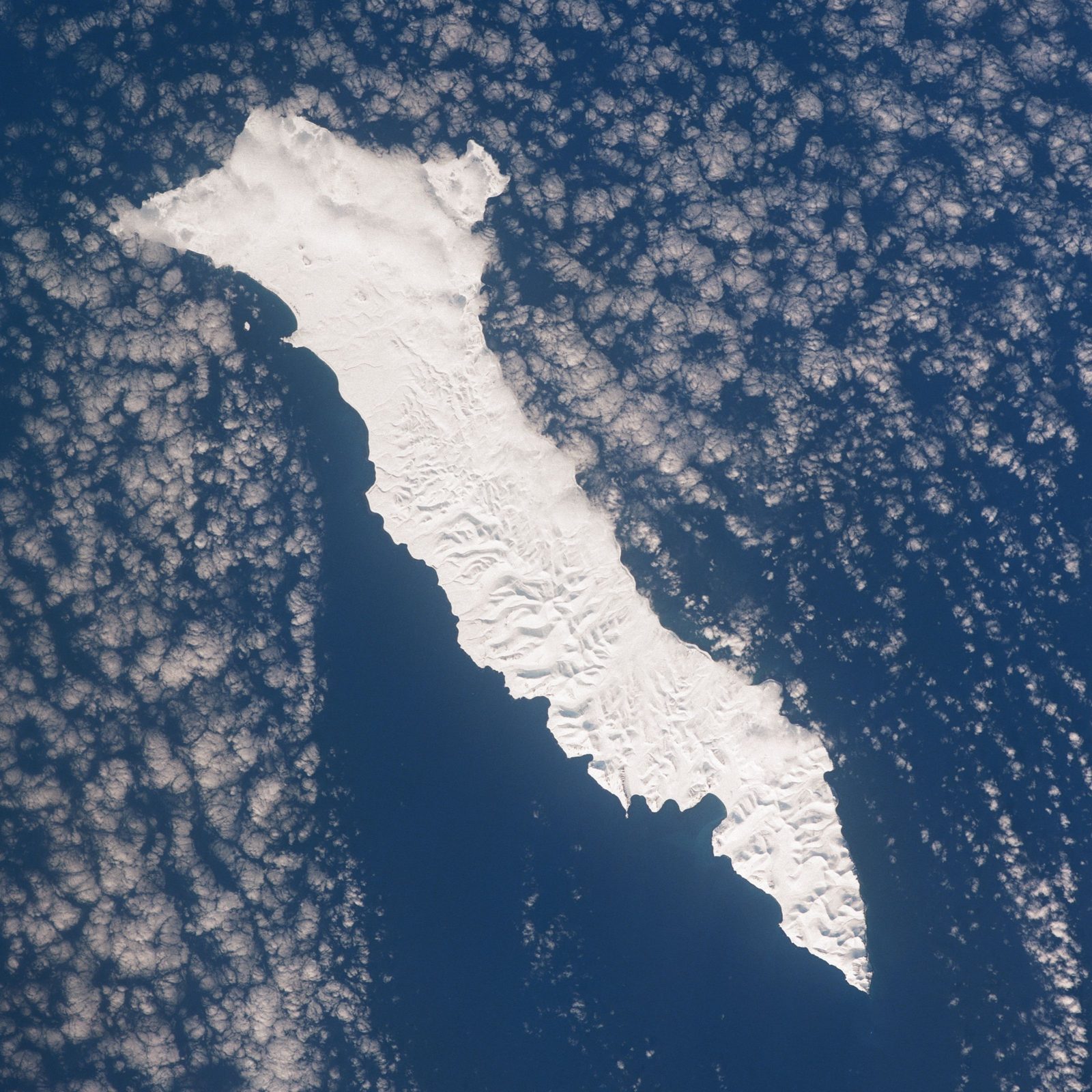
By November 1741, the men aboard St. Peter were looking for home. They had reached the American coast and turned back toward Kamchatka. Scurvy had weakened the crew. When land appeared, it was not the mainland they needed. Their ship came ashore on an island where they would spend the winter.
Vitus Bering died there. The survivors took the wreck apart and built a smaller boat, which carried forty-six men home the following summer. Bering had already sailed the strait named for him in 1728 without seeing America. The 1741 voyage reached the American coast. Its final challenge was keeping enough of the crew alive to report what they had seen.
Two ships, one fog
The Second Kamchatka Expedition was not a single ship with a romantic brief. It was a state project: maps, tribute, a sea route, a scientific party, and the kind of paperwork an empire generates when it wants a coast to become a possession. Two vessels left Avacha Bay in the early summer of 1741 — June in the chronology most English-language surveys repeat, the beginning of July in a Norwegian one. The disagreement is a few weeks, not a different voyage. Bering commanded St. Peter. Aleksei Chirikov commanded St. Paul. They separated in fog and did not find each other again.
Chirikov made his own American landfall, farther south, and lost both of his landing boats with the men in them. That loss is its own story, and it is not this one. What matters for the island is that Bering’s ship went on alone. On 16 July the lookouts raised a high coast and a peak the expedition would call Mount Saint Elias. They had crossed. The continent on the far side of the water was not a chartmaker’s hope.
They did not stay to found anything. Fresh water was short. Scurvy was already in the crew. The season in that latitude does not negotiate. St. Peter turned back toward Kamchatka along the island chain that later maps would call the Aleutians, stopping where the water allowed, burying men where the water did not.
A shore that was not Kamchatka
By November the ship was a sickroom with sails. Contemporary accounts and Steller’s later journal agree on the shape of the week if not on every name: land was sighted, the officers argued about whether it was the Kamchatka coast they were owed, and the vessel was driven ashore in the first days of the month. It was not Kamchatka. It was an island, uninhabited, about a hundred miles off the coast they wanted. Later it would be called Bering Island. At the time it was weather, driftwood, and foxes that had never learned to fear people.
The hull did not survive the landing as a ship. What could be dragged above the tide became the material of a winter: spars, canvas, the iron it was still rational to keep. The crew dug pits in the sand and roofed them. Steller, who had spent the voyage furious at officers who would not let a naturalist do his job, now had a field no academy had scheduled. He treated scurvy with plants the island would give up. He also wrote. His journal is the reason this winter is narratable, and it is a journal with a side. He is not a witness you can launder into a neutral log.
What the winter will not let us count
Bering died on the island on 8 December 1741, which is the date in the naval chronology and in Bancroft. A later Russian retelling says 6 December. Two days is not a reason to average them. He was sixty. The scene is Steller’s, and Steller was not fond of him: a sand pit, boards that did not keep the sand out, a death he attributed to hunger, thirst, cold, adversity, and grief. A captain can die of scurvy without supplying a moral. We will not invent a last hour on top of Steller’s.
The winter killed more than the captain. One ship’s tally that later surveys repeat puts the company of St. Peter at seventy-five and the deaths after the wreck, through the winter, at about thirty. Fold in the scurvy cases from the crossing and the number gets rounder and less honest. The careful fact is smaller and worse. Men who had already crossed from Asia to America died of a disease with a known remedy, on an island with plants that could supply it, because a ship is a bad hospital and a sand pit is a worse one.
The boat that was the proof
In the spring the survivors broke St. Peter down and built a smaller vessel from the timber. Forty-six men left the island in mid-August 1742 under the senior officer, Sven Waxell, and anchored in Avacha Bay on 26 August. With them went the news that the American coast had been sighted, charted at a distance, and left. With them also went sea-otter pelts. The furs were worth more, in the short term, than the map. The report did not reach the Admiralty as a finished thing until November, and most of the expedition’s paper did not close in St. Petersburg until years after that.
That is the near-miss inside the success. The expedition had done the thing it was sent to do. The captain who could have stood in St. Petersburg and said so was already in the sand. The state got a coast. The promyshlenniki who read the same news got a reason to sail east for otter, and they did, hard enough that later conservation arguments would have to be invented to describe what they took. A geographic proof and a slaughter can leave the same harbor.
Why the hook is not the essay
On a forum, Bering arrives as irony: the man who found the strait died one island short of home. The dates are better than the irony. He had found the strait thirteen years earlier and missed America in the fog. He found America in 1741 and missed home by a hundred miles and a disease the ship’s diet had been feeding all summer.
If you came here from a sentence about a captain and an island, stay for the less shareable fact. Forty-six men built a boat out of the wreck and carried the proof home. The proof was accurate. What the empire and the fur traders did with an accurate proof is the part the hook leaves off, because it does not fit in a sentence.
A story worth passing on?